We are writing today with our next weekly construction lookahead.
Please be aware that Monday is an RDO and there will be no works on site.
Anzac Station entrance construction – Tram Interchange
In the tram interchange station entrance, next week work will continue on the construction of the oculus structure. The last of the canopy support legs will be installed early next week, along with the timber and steel canopy support beams being lifted and secured into place.
Tonight, the last of the support legs will be delivered to site. As it is an oversized delivery, it will be completed between 12-5am. Crews will be reminded of all noise mitigation requirements ahead of the shift.
In the coming weeks the timber sections will begin to be lifted and secured into place, these works may at times need to continue until 10pm, however next week all works will be within standard working hours. We’ll advise next week if any extended hours are required.
Station box construction
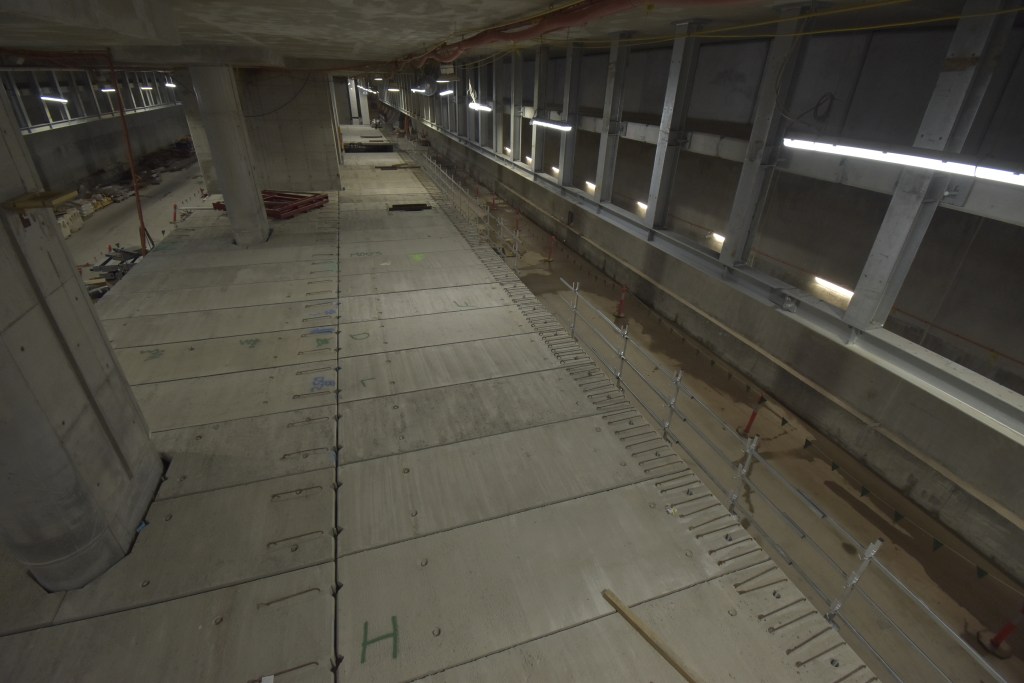
No change to the works going on underground next week. Precast over track exhaust (OTE) installation continues, along with the framework that will form the platform doors. Installation of the precast sections of the future station platform are underway. The precast segments will be lowered into the station box until 10pm, while preparation works ahead of their installation will continue overnight. This activity is located entirely at platform level, and is unlikely to generate high noise at surface after 10pm.
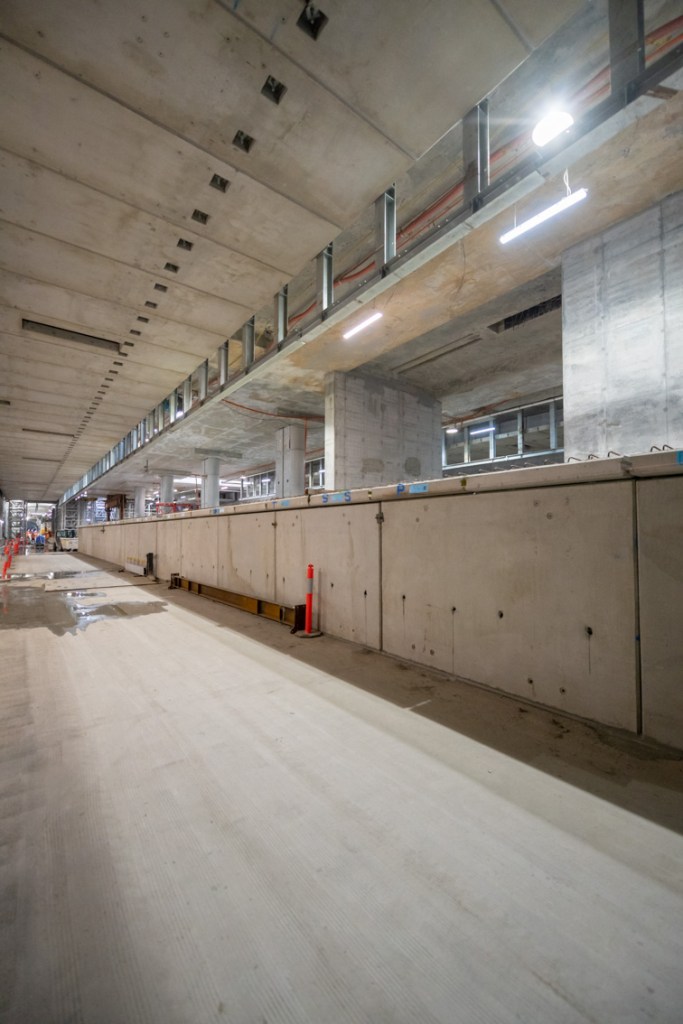
Today, we’ve included a picture of the platform precast installation progress. In this picture, you can also see above the platform some of the over track exhaust precast that has been installed, as well as the platform screen door steel framework.
Internal walls and permanent columns continue to be constructed in the station box, moving from south to north, as well as continuing the construction of the headwall that connects the station box to the tunnels. These works will involve steelfixing, formworking and concrete pours. As with all concrete pours, they must be completed continuously, and may run over normal construction hours.
As per the construction notice, steel fixing will continue in the station box 24/7.
Acoustic insulation, and mechanical electrical and plumbing fit out works are also continuing in the station box.
Plunge columns will continue to be removed, as well as firewall shotcreting, heading from south to north in the station box. Works on the plunge columns will continue within the station box until 10pm, and preparation works for the firewall shotcreting will continue on night shift. These activities are unlikely to generate high noise at surface level.
Now that the large crane we’ve been using has been dismantled and removed from site, the crane set up towards the northern end of site near Domain Road will be our primary crane lowering precast and equipment into the station box. This crane will be used up until 10pm on work nights. A second smaller crane will arrive to site next week to assist with deliveries into station box, and be set up towards the southern end of site. This crane may also be required until 10pm on work nights.
Surface Works
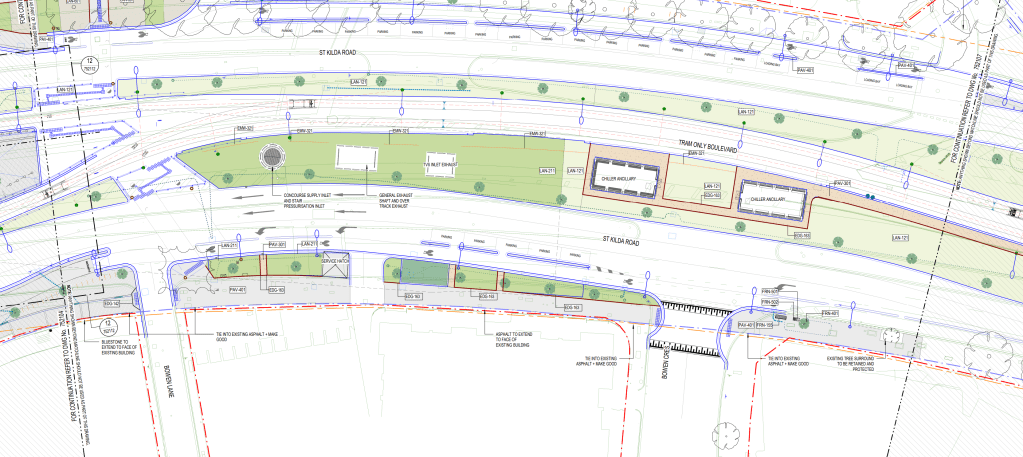
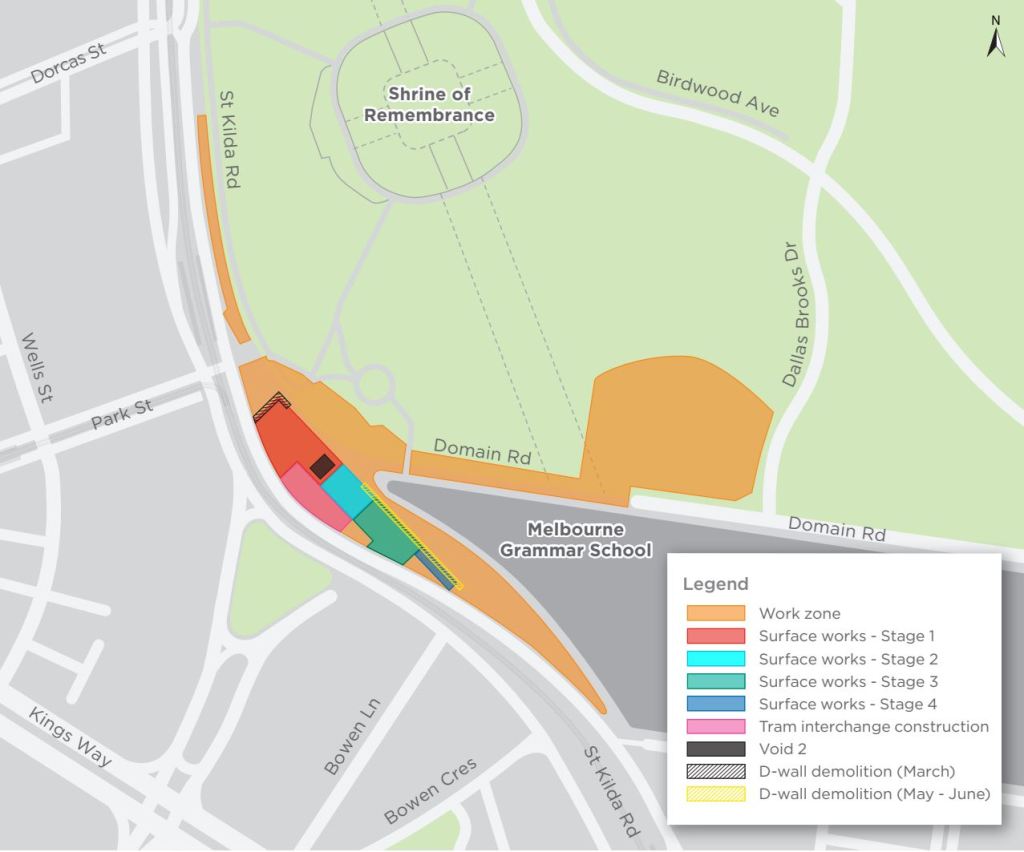
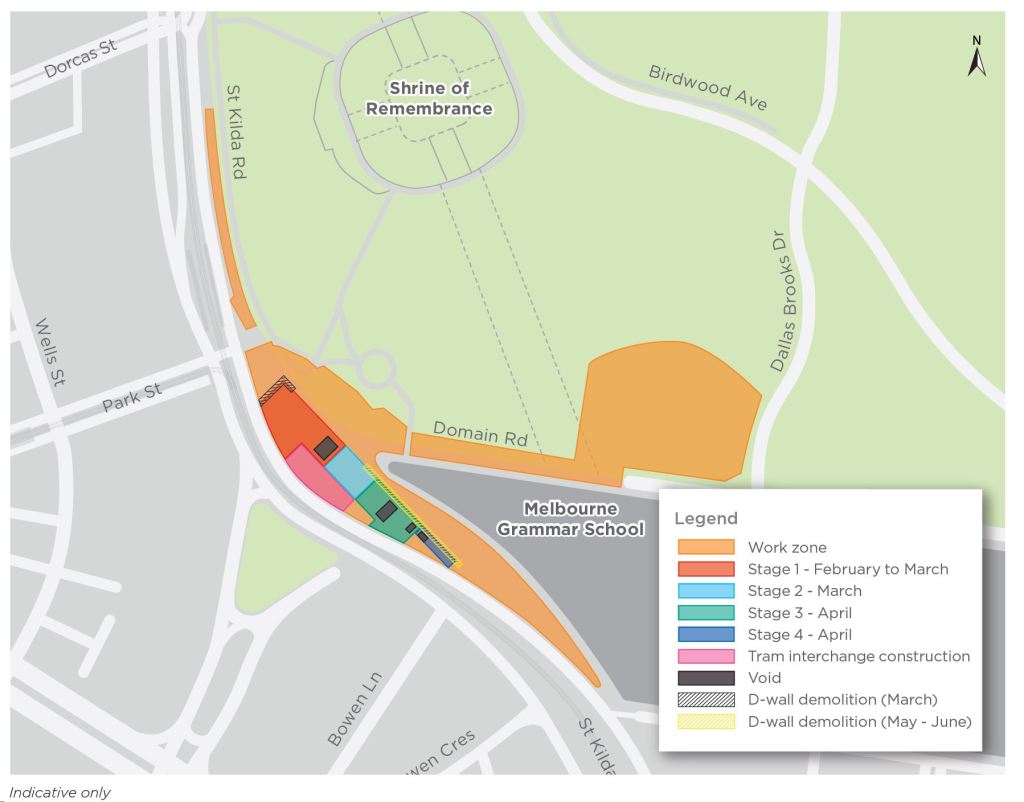
Now that the large crane has been demobilised, demolition of the temporary slab has begun in that area. In addition to works there, the D-wall demolition will continue, as well as the surface works in sections 2 and 3.
These works will generate periods of high noise and the works will be carried out during normal working hours.
In addition to the surface works listed below, waterproofing and screeding in the area will continue. Non-Destructive-Digging trucks – also known as sucker trucks – will be used on site to clean out any debris in the strip of reinforced steel prior to concrete being poured in the sections of delayed pour strip.
If any owners want the cabling extended to their particular car bay can you please let Paul know. The cost will be about $2400 plus GST and this excludes a charging device. I’d recommend that you wait until you have an electric car before you add your charger as this technology may change.
Last night someone on Level 1 was doing some cooking. They burnt their dinner and their kitchen filled with smoke. They opened their front door to try and help get it to escape. That triggered the building smoke detectors.
They immediately contacted Paul to warn him what had happened.
The fire brigade was here in about 5 minutes. The people who caused the issue, met the fire guys downstairs and took full responsibility for the accident.
Some people asked why only Level 1 (and 2?) alarm bells were triggered. As I understand there is a system of cascading alarms, so sound the alarm on the problem floor first to get those people out. Then other floors would have sounded if the fire brigade had not taken action.
The sprinklers are triggered by heat.
If your kitchen fills with smoke, it is probably best to open the outside doors/windows in the first instance.
Just a reminder – do NOT use the lift when the alarms are sounding
I’ve had a few queries, so let me add a bit more to the story.
When we did the survey earlier in the year, we had 20 people respond and 4 of them said they expect to buy an EV in the next 2 years and another 5 in the 2-5 year time period.
The solution we are installing will allow up to 30 car bays to be connected, we expect that this will be sufficient for at least 5 years.
It is possible that some owners may wish to add a charger to their bay even if they do not buy an EV. This will make rental apartments for attractive for some tenants. Regardless we feel we are installing enough capacity 5 years.
We can expand the capacity to all car bays if required with further investment. We only envisage doing this when we are getting close to the 30 bay limit.
While the EV world is changing quickly, the backbone, the main cost of what we are installing, is mainly basic cables, it is the chargers that owners will install that will evolve most over time. So I expect that little of the common infrastructure will become dated.
You will see very little difference in the carpark. There will be some cabling up high and some boxes installed in our switchboard room.
No owner is being forced to install cabling and charger to their bay. If you do not want one, that is fine.
The current estimates for installation are $2400 plus GST for cabling and $1850 plus GST for a charger. So about $4700 inc GST.
The installation will be a bit like installing a general power point with an extension cable and each individual bay will be assessed by an electrician when you request a connection.
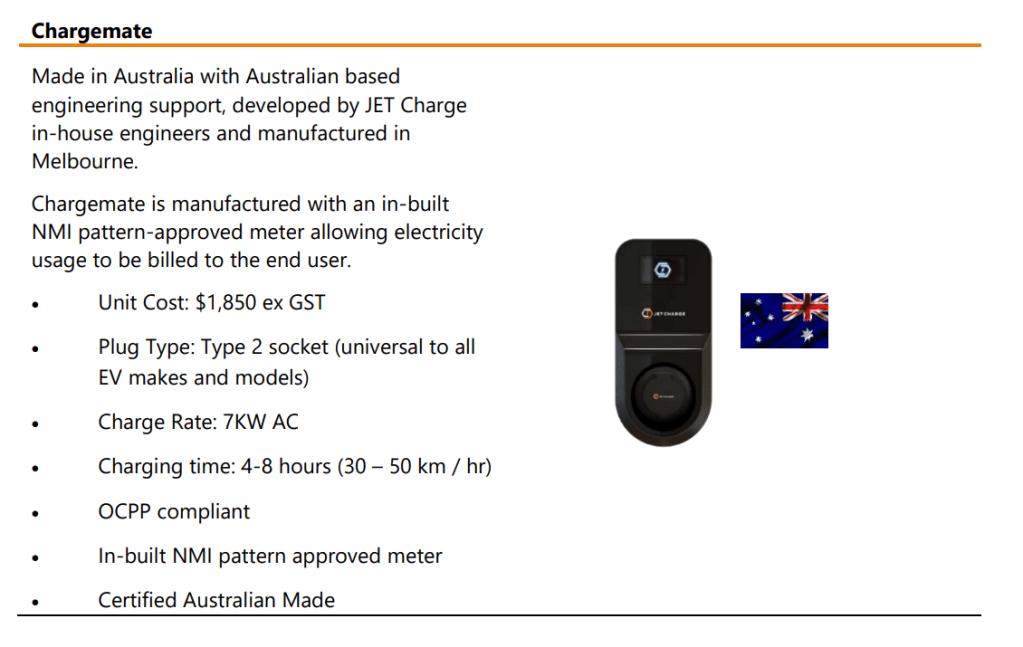
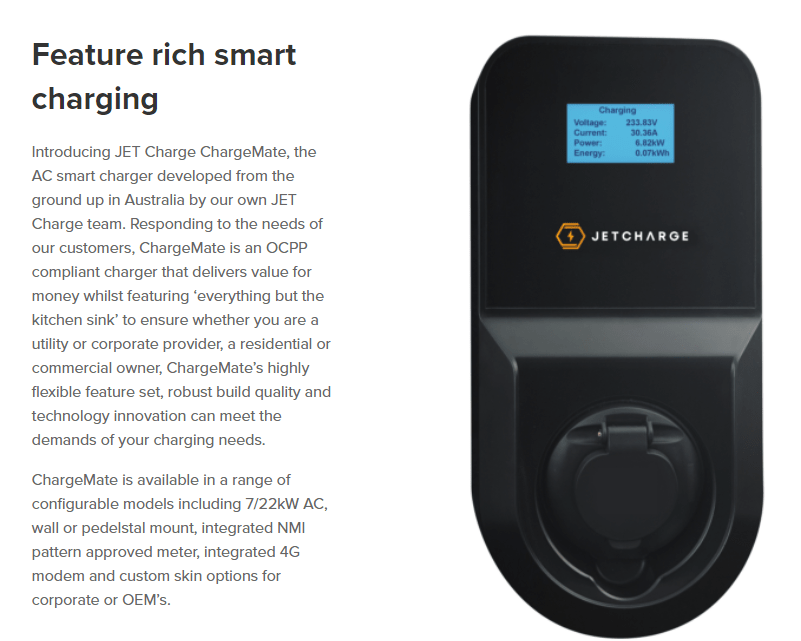
The chargers we are recommending today are JetCharge Chargemates. They work with all EVs sold in Australia. The chargers that can be installed at any time must be compliant with our system.
You can see the ‘power point’ with cover in this picture. That gives you an idea of the size of the charger. EV owners then have a special cable (that comes with their car) running from this device to their car.
The Committee has decided to install the basic infrastructure for charging electric vehicles (EVs) at a cost of approx. $35K. It will be installed in May.
Some things to note
There will be no levy required to fund this work
This work will provide the ‘common backbone’ but users wanting to connect will still need to pay for cabling to their bay and their own charger. These must be arranged through the OC.
The common infrastructure that the OC is funding ensures that we do not place other building power circuits at risk and ensures that the EV owner is immediately billed for power used.
Our insurance company has been consulted and confirmed that this does not increase our risk and therefore will not impact our premium.
Reference sites consulted commented that the costs for our building are modest compared to many other buildings.
Two estate agents who have sold apartments in our building both commented that they are receiving more and more queries from buyers about EV charging. One agent commented that he has lost St Kilda Rd sales due to the lack of EV charging capability. They both commented that all new apartment blocks MUST have EV charging.
As I have personally ordered an EV, I stood aside when the Committee voted on this matter.
We are writing today with our next weekly construction lookahead.
Next week will be a shorter week than usual with the Easter long weekend. Works will stop on Thursday, with some works to decommission the large crane commencing from the following Tuesday. We will provide an update on the crane works next Thursday.
Anzac Station entrance construction – Tram Interchange
All eight of the station canopy legs that are connected to the pedestals at concourse level have now been installed in the oculus. After Easter, the four remaining legs will be installed.
This week, the first of the timber rafters and steel spline beams have been delivered to site, with the first of their installation underway. This work will continue next week.
Station box construction
No change to the works going on underground next week. Precast over track exhaust (OTE) installation continues, along with the framework that will form the platform doors. Installation of the precast sections of the future station platform are underway. The precast segments will be lowered into the station box until 10pm, while preparation works ahead of their installation will continue overnight. This activity is located entirely at platform level, and is unlikely to generate high noise at surface after 10pm.
Internal walls and permanent columns continue to be constructed in the station box, moving from south to north, as well as continuing the construction of the headwall that connects the station box to the tunnels. These works will involve steelfixing, formworking and concrete pours. As with all concrete pours, they must be completed continuously, and may run over normal construction hours.
As per the construction notice, steel fixing will continue in the station box 24/7.
Plunge columns will continue to be removed, as well as firewall shotcreting, heading from south to north in the station box. Works on the plunge columns will continue within the station box until 10pm, and preparation works for the firewall shotcreting will continue on night shift. These activities are unlikely to generate high noise at surface level.
As mentioned in last week’s update, the crane on surface will be required for use up until 10pm on work nights. The void in the south box continues to be closed up – and as a result a smaller crane has been mobilised in the northern section of site and will begin to be used to lower pre-cast segments into the northern void. This northern void will transition to become the main access down into the station box. The larger crane will be demobilised and taken from site prior to the Easter later this month. There will be times when both the large crane and the new smaller crane will be used on surface until 10pm at the same time.
Today we’ve included a photo of the progress of the platform construction down at the base of the station box. The team are making good progress as they construct the platform from south to north. Once the full platform is constructed, a capping slab of concrete is poured.
Surface Works
Surface breakout at the northern and middle sections of site have been progressing well this week. Below is a detailed run down of works to occur next week.
These works will generate periods of high noise and the works will be carried out during normal working hours.
In addition to the surface works listed below, waterproofing and screeding in the area will continue. Non-Destructive-Digging trucks – also known as sucker trucks – will be used on site to clean out any debris in the strip of reinforced steel prior to concrete being poured in the sections of delayed pour strip.
Saturday 9/4
Monday 11/4
Tuesday 12/4
Wednesday 13/4
Thursday 14/4
Spray and cleanout of stage 2 delayed strip pourCovered access construction through stage 2Stage 2 backfilling

 The Botanica
You must be logged in to post a comment.